Well, the "Just Right" hybrid turnips I planted in December are bolting, right on schedule to attract bees to pollinate the Royal Rosa apricot and the Flavor Delight Aprium.
"White Lady" turnip, planted the same time, is not bolting yet. "Just Right" is a great fall turnip, resistant to cold. Not such a great spring turnip. Just as described in the catalog.
Showing posts with label Fruit Trees. Show all posts
Showing posts with label Fruit Trees. Show all posts
Thursday, February 24, 2011


Monday, August 16, 2010
Pluots and Sugar Plums
Last week, I picked samples of three varieties of Pluots and our only European plum:

The yellow ones at the top are Flavor Queen Pluots: Pure sweetness - too sweet for some people when fully ripe. Clingstone. This variety does not set fruit easily. I only have a few fruits this year.
To the right are Geo Pride Pluots - tender, flavorful, sweet. Semi-freestone when soft-ripe.
At the bottom are this year's first Sugar Plums - a small European variety which survives in our climate. They can be dried into prunes without special treatment. Sweet, like the typical prune-plum.
On the left are Dapple Dandy Pluots: Bumper crop this year, as most years. Firm, clingstone.

The yellow ones at the top are Flavor Queen Pluots: Pure sweetness - too sweet for some people when fully ripe. Clingstone. This variety does not set fruit easily. I only have a few fruits this year.
To the right are Geo Pride Pluots - tender, flavorful, sweet. Semi-freestone when soft-ripe.
At the bottom are this year's first Sugar Plums - a small European variety which survives in our climate. They can be dried into prunes without special treatment. Sweet, like the typical prune-plum.
On the left are Dapple Dandy Pluots: Bumper crop this year, as most years. Firm, clingstone.
Thursday, August 5, 2010
Summer Fruits
It's been seasonably hot - with highs around 100 degrees for several days, almost 40 degrees cooler just before sunup. The peaches and nectarines appreciate the weather more than the plums and Pluots do. But we have an assortment right now. Here is a platter full of fruits:
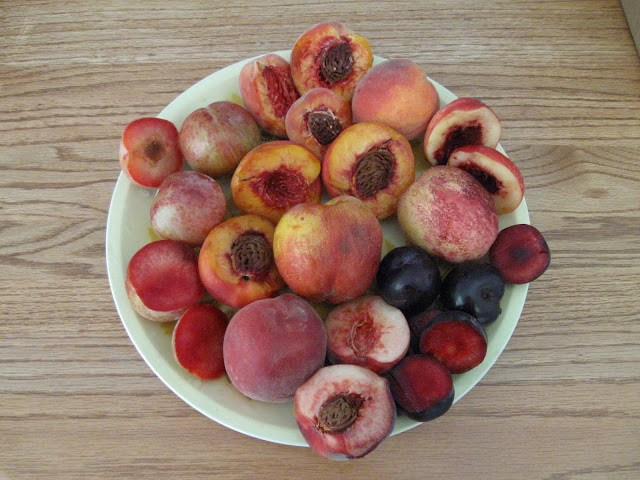
At the top are July Elberta peaches - freestone, suitable for canning (much less firm than cling peaches), great for jam, old-fashioned yellow peach flavor fresh. To the right are some of the last Heavenly White Nectarines - also freestone. Sweet, growing on a vigorous tree. Skin is slightly tough. I may not have watered enough when they were small. I would have bigger fruits on both of the varieties above if I had thinned more carefully.
Below the Heavenly White nectarines are some Burgundy plums. They are sweet, firm, quite mild and red all the way through. They hang well on the tree for quite a while without losing quality. Some people find them similar to Bing cherries. Clingstone. Recommended for drying if you're patient enough to cut the fruit off the pit. The blossoms are self-pollenizing and it is a good pollenizer for second-early blooming plums and Pluots.
At the bottom are Snow Beauty peaches. Freestone. A very nice white peach for California. Above them, in the center, are Fantasia nectarines - an old-fashioned, very flavorful variety - not as sweet as some of the newer ones. Freestone. A great fruit. I learned from "Fruitnut" on the Garden Web that this variety may not produce fruit if not watered well early in the season. I did better this year.
To the left are Dapple Dandy Pluots - the most well-known commercial Pluot. It was once promoted as "dinosaur eggs". Some of the mottled skin coloration comes from a plum parent - Mariposa. They grow on a vigorous, prolific tree. The fruit is firm and sweet. Clingstone. Not the most flavorful Pluot available, but still very tasty. There are some similar-looking varieties which ripen at different seasons which are very inferior in flavor. Their inferior flavor is even noted in the wholesale catalog for the trees. So try to make sure you get the real "Dapple Dandy" if you buy some at a farmer's market or something.

At the top are July Elberta peaches - freestone, suitable for canning (much less firm than cling peaches), great for jam, old-fashioned yellow peach flavor fresh. To the right are some of the last Heavenly White Nectarines - also freestone. Sweet, growing on a vigorous tree. Skin is slightly tough. I may not have watered enough when they were small. I would have bigger fruits on both of the varieties above if I had thinned more carefully.
Below the Heavenly White nectarines are some Burgundy plums. They are sweet, firm, quite mild and red all the way through. They hang well on the tree for quite a while without losing quality. Some people find them similar to Bing cherries. Clingstone. Recommended for drying if you're patient enough to cut the fruit off the pit. The blossoms are self-pollenizing and it is a good pollenizer for second-early blooming plums and Pluots.
At the bottom are Snow Beauty peaches. Freestone. A very nice white peach for California. Above them, in the center, are Fantasia nectarines - an old-fashioned, very flavorful variety - not as sweet as some of the newer ones. Freestone. A great fruit. I learned from "Fruitnut" on the Garden Web that this variety may not produce fruit if not watered well early in the season. I did better this year.
To the left are Dapple Dandy Pluots - the most well-known commercial Pluot. It was once promoted as "dinosaur eggs". Some of the mottled skin coloration comes from a plum parent - Mariposa. They grow on a vigorous, prolific tree. The fruit is firm and sweet. Clingstone. Not the most flavorful Pluot available, but still very tasty. There are some similar-looking varieties which ripen at different seasons which are very inferior in flavor. Their inferior flavor is even noted in the wholesale catalog for the trees. So try to make sure you get the real "Dapple Dandy" if you buy some at a farmer's market or something.
Saturday, July 10, 2010
Cucumbers, Climbing Squash Plants, Fruit Tree Pests
Below is a photo of the cucumbers I picked yesterday, with some of the tomatoes we picked at the same time. We got some LONG cucumbers. At the bottom are two Natsuhikari - our first of the season. Then a ribbed Suhyo TK, then the tomatoes, then several Summer Dance cucumbers - not all as perfect as they usually are.

We've had a spider mite invasion of several of our stone fruit trees. Today I sprayed the Heavenly White Nectarine tree pictured below with a jet of water. Much to the consternation of our dog, Maggie. The tree is due for some extra pruning this summer. It's currently losing a few leaves due to the mites. Hope rinsing off the leaves gives predators of the mites a chance. They're very difficult to control with insecticides. You can see one of F's winter squash plants climbing the tree. He planted several of them where they would tend to overtake our plants.

Below is our drenched Warrior Princess Maggie resting after her epic battle with the water hose.


We've had a spider mite invasion of several of our stone fruit trees. Today I sprayed the Heavenly White Nectarine tree pictured below with a jet of water. Much to the consternation of our dog, Maggie. The tree is due for some extra pruning this summer. It's currently losing a few leaves due to the mites. Hope rinsing off the leaves gives predators of the mites a chance. They're very difficult to control with insecticides. You can see one of F's winter squash plants climbing the tree. He planted several of them where they would tend to overtake our plants.

Below is our drenched Warrior Princess Maggie resting after her epic battle with the water hose.

Monday, July 5, 2010
First Plums and Pluots
Below is a plate showing, at the top, the superlative Flavor Supreme Pluot, the classic Santa Rosa Plum on the left and Weeping Santa Rosa at the bottom. There is a whole and a cut fruit if each variety . These were picked last week, just as our apricots were finishing up.

Flavor Supreme has lots of sweetness, similar in this way to a typical European plum, but with sprightliness and complex flavor characteristic of an Asian plum. It has a little apricot in its background, along with Santa Rosa and Mariposa plums, which are common in the parent lines of new varieties of plums and Pluots. It tastes best when it first starts to soften, while the skin is still mostly green. It has a bit of crispness at this point. Eventually, the flesh will turn a deep maroon, but by then much of the complex flavor will be gone. My experience this year has been that the fruit can develop a slightly "cooked" or oxidized flavor if it ripens when the temperature gets to 107 degrees. Fruits which ripened after the high heat (daytime highs of about 92 to 99 degrees) were far better. The same was true for the plums below.
Flavor Supreme grows on a vigorous tree with big leaves, but its blossoms are not very attractive to bees. It's a good idea to graft in some early-blooming pollenizers, like the old California commercial plum, Inca, or one of the other early-blooming Pluots. Or, you can plant your pollenizers very close to the Flavor Supreme, or bring over some vases full of blooming branches to place in the tree. Right now, the tree is afflicted with spider mites, and as soon as all the fruit are picked, it's going to be pruned and blasted with a jet of water in the mornings. I've already started spraying the tree with water, trying to avoid the fruit as much as possible.
This year, the fruit is ripening with Santa Rosa, indicating that rain prevented setting of the earliest blooms. As with our apricots. Normally, Flavor Supreme starts to ripen well before Santa Rosa.
Santa Rosa is the classic California Asian plum, introduced by the legendary breeder Luther Burbank. It is tart at the pit and astringent under the skin, with a sweet layer in between which has a lushly complex flavor. It tastes a bit "wild". It is not sweet or firm enough for some modern tastes, but this is a fruit that lets you know you're alive when you eat it. A Santa Rosa at its peak is, in my opinion, a wonderful thing. Some people peel it before eating. Like Flavor Supreme, it loses flavor if over-ripe. It makes very flavorful jams and jellies. Leave the skins on.
The blossoms are self-pollenizing, and this tree is the classic pollenizer for Asian plums and Pluots which need cross-pollination. It has a wide climate adaptability. The tree is vigorous and easy to care for. Perhaps too vigorous for some people. Summer pruning is key to controlling its size. If compatible with your soil, you could also consider planting it on a dwarfing rootstock (the same is true of Flavor Supreme, another vigorous tree).
Weeping Santa Rosa is a Floyd Zaiger development, like Flavor Supreme Pluot. It's one of his earlier releases, now off patent. The fruits grow on a tree with a weeping habit. It is a little sweeter that Santa Rosa (wins taste tests) and ripens slightly later than Santa Rosa. It can be picked when a little firmer and still have great flavor.
Below is our plate of fruit under the Weeping Santa Rosa tree by our front walk. You can see a couple of fruits hanging from the tree next to the daylily blossom. The cut fruit in the photo above is slightly under-ripe. At perfection, the flesh will have a slight rosy blush, a little less than the photo of the Santa Rosa fruit on the left.
Like Santa Rosa, its blossoms are self-pollenizing and can pollenize other varieties. The tree is often grafted onto dwarfing rootstock for ornamental use, but you can also prune it to the shape you like. It has a wider climate adaptability than Flavor Supreme, but probably not as wide as Santa Rosa. The little flower underneath is a cross between a Martha Washington geranium (well, pelargonium) and a scented species. It survives in our climate better than the true Martha Washington types. But the bloom you see lost a petal during the photo session, and it may be our last for the year.


Flavor Supreme has lots of sweetness, similar in this way to a typical European plum, but with sprightliness and complex flavor characteristic of an Asian plum. It has a little apricot in its background, along with Santa Rosa and Mariposa plums, which are common in the parent lines of new varieties of plums and Pluots. It tastes best when it first starts to soften, while the skin is still mostly green. It has a bit of crispness at this point. Eventually, the flesh will turn a deep maroon, but by then much of the complex flavor will be gone. My experience this year has been that the fruit can develop a slightly "cooked" or oxidized flavor if it ripens when the temperature gets to 107 degrees. Fruits which ripened after the high heat (daytime highs of about 92 to 99 degrees) were far better. The same was true for the plums below.
Flavor Supreme grows on a vigorous tree with big leaves, but its blossoms are not very attractive to bees. It's a good idea to graft in some early-blooming pollenizers, like the old California commercial plum, Inca, or one of the other early-blooming Pluots. Or, you can plant your pollenizers very close to the Flavor Supreme, or bring over some vases full of blooming branches to place in the tree. Right now, the tree is afflicted with spider mites, and as soon as all the fruit are picked, it's going to be pruned and blasted with a jet of water in the mornings. I've already started spraying the tree with water, trying to avoid the fruit as much as possible.
This year, the fruit is ripening with Santa Rosa, indicating that rain prevented setting of the earliest blooms. As with our apricots. Normally, Flavor Supreme starts to ripen well before Santa Rosa.
Santa Rosa is the classic California Asian plum, introduced by the legendary breeder Luther Burbank. It is tart at the pit and astringent under the skin, with a sweet layer in between which has a lushly complex flavor. It tastes a bit "wild". It is not sweet or firm enough for some modern tastes, but this is a fruit that lets you know you're alive when you eat it. A Santa Rosa at its peak is, in my opinion, a wonderful thing. Some people peel it before eating. Like Flavor Supreme, it loses flavor if over-ripe. It makes very flavorful jams and jellies. Leave the skins on.
The blossoms are self-pollenizing, and this tree is the classic pollenizer for Asian plums and Pluots which need cross-pollination. It has a wide climate adaptability. The tree is vigorous and easy to care for. Perhaps too vigorous for some people. Summer pruning is key to controlling its size. If compatible with your soil, you could also consider planting it on a dwarfing rootstock (the same is true of Flavor Supreme, another vigorous tree).
Weeping Santa Rosa is a Floyd Zaiger development, like Flavor Supreme Pluot. It's one of his earlier releases, now off patent. The fruits grow on a tree with a weeping habit. It is a little sweeter that Santa Rosa (wins taste tests) and ripens slightly later than Santa Rosa. It can be picked when a little firmer and still have great flavor.
Below is our plate of fruit under the Weeping Santa Rosa tree by our front walk. You can see a couple of fruits hanging from the tree next to the daylily blossom. The cut fruit in the photo above is slightly under-ripe. At perfection, the flesh will have a slight rosy blush, a little less than the photo of the Santa Rosa fruit on the left.
Like Santa Rosa, its blossoms are self-pollenizing and can pollenize other varieties. The tree is often grafted onto dwarfing rootstock for ornamental use, but you can also prune it to the shape you like. It has a wider climate adaptability than Flavor Supreme, but probably not as wide as Santa Rosa. The little flower underneath is a cross between a Martha Washington geranium (well, pelargonium) and a scented species. It survives in our climate better than the true Martha Washington types. But the bloom you see lost a petal during the photo session, and it may be our last for the year.

Thursday, June 17, 2010
First Stone Fruits, 2010

We had a difficult spring for stone fruits this year - lots of rain during blossom time. For the first time, fruit set was sparse on Flavor Delight Aprium. Also on Royalty and Golden Amber apricots, plus my favorite, Harcot. Not much going on with Canadian White Blenheim, either, but this is no surprise, as it needs a late pollinator and is in a marginal zone for winter chill here.
On the other hand, we got a good fruit set on Blenheim apricot, a disease-prone variety. And it is starting to ripen before temperatures reach 100 degrees - unusual around here. No pit burn. It's a great fruit if you're in a climate which is friendly to it. For example, if you live in Santa Rosa, in what was once called "The Valley of Heart's Delight" based partly on the fruits grown there. Various apricot varieties can be quite picky about the climates they prefer. Apricot success here this year is all about the weather.
Back to the start of the harvest season: Our first fruits were little Royal Rosa apricots. They were better this year than in the past. I think that their water was restricted a little as they ripened. They also need to be dead-ripe before you pick them, or they are bland.
Next came Flavor Delight Apriums - nice fruits - and Royalty (Not Royal), a big, mushy fruit on wind-resistant spurs which David likes because it reminds him of his Grandpa's apricots.
Harcots started soon after Flavor Delight. Not many of them, but they were big and luscious.
Some of them are pictured above with Flavor Delight apriums, a little yellow plumcot (blushing to red) from LE Cooke wholesalers and Arctic Star nectarine. The plumcot is an interesting fruit: soft and tender. It loses quality when it goes beyond yellow with a little blush. It has a little bit of a delicate floral flavor. At its best, it's sweet, but can also tend toward being insipid. I think of them as resembling a wild fruit. Wild fruits seem to come in two main types - highly flavored and tart or even astringent, or slightly sweet and tending toward the insipid. This fruit is closer to the latter category. Some people really like them a lot. I think they would be good combined with cranberries for a less-assertive sauce.
They tend to ripen over a very short period of time, especially in years hotter than this one. The tree is compact and attractive, with nice leaves and showier blossoms than most plums grown for fruit. It's easy to care for. It blooms late in the plum season here, and it may cross-pollinate Emerald Beaut - a prized variety of plum. It takes a few years to start blooming, and often blooms on main branches.
Arctic Star white nectarine (the reddish fruit in the picture) are one of breeder Floyd Zaiger's great family of super-sweet fruits. They can be enjoyed firm-ripe or soft and very sweet. The fruits should be thinned more than I thinned them this year, given ample water until they start to ripen, and protected from insects through dormant spraying, garden cleanup, etc. This will help prevent the bitter almond off-flavors and stunted fruits which can occur in white nectarines.
Monday, March 15, 2010
March 15: Official "frost-safe" planting date
Well, it was cold and windy on Saturday, nicer on Sunday and in the 70s today. David finished tilling and prepared a row for the greens and the rest of the beans I had started. Hope they didn't stay in their little containers too long.
Canadian White Blenheim has some blooms now, coinciding this year with a few stragglers on Blenheim and more on Golden Amber, which is further from the big CWB tree. Chinese also had a couple of blooms.
'
Emerald Beaut plum is blooming right with our little Plumcot. Hope it will cross-pollinate. I took some branches over in a bottle-vase. Cassleman and Flavor King still have a few blooms open, too.
Time to get going in the garden.
Canadian White Blenheim has some blooms now, coinciding this year with a few stragglers on Blenheim and more on Golden Amber, which is further from the big CWB tree. Chinese also had a couple of blooms.
'
Emerald Beaut plum is blooming right with our little Plumcot. Hope it will cross-pollinate. I took some branches over in a bottle-vase. Cassleman and Flavor King still have a few blooms open, too.
Time to get going in the garden.
Friday, February 12, 2010
Popcorn Popping, planting greens
Today, the Flavor Delight Aprium tree and the Royal Rosa Apricot started blooming. It's a beautiful day, but probably not quite warm enough for honeybees to be really happy yet. Hope some other insects are out.
I plants some "summer turnips" using the Winter Sowing method today. An experiment. I really prefer turnips in the fall. Five 6-oz. deli cups fit in a fried chicken tray from Walmart. Cut some slices out of the bottom edge of the cups and poked some holes in the bottom of the chicken tray. The top is already vented. Used a UV resistant industrial marker (Sharpie) to mark the cups. We're comparing:
White Lady to Tokyo Cross
Hakeuri to Oasis
Just Right (a fall turnip) as control.
I don't think any of these, except maybe Tokyo Cross, are true, 100% turnips. They have sweet, non-hairy leaves which are much milder than regular turnip greens.
I also started some greens and assorted brassicas - 9 deli cups in a pumpkin pie tray from Costco, with plastic wrap snapped into the rim. Poked 2 holes in plastic above each cup, and a few extra holes. The sun is out now, and I don't want any over-heating.
I plants some "summer turnips" using the Winter Sowing method today. An experiment. I really prefer turnips in the fall. Five 6-oz. deli cups fit in a fried chicken tray from Walmart. Cut some slices out of the bottom edge of the cups and poked some holes in the bottom of the chicken tray. The top is already vented. Used a UV resistant industrial marker (Sharpie) to mark the cups. We're comparing:
White Lady to Tokyo Cross
Hakeuri to Oasis
Just Right (a fall turnip) as control.
I don't think any of these, except maybe Tokyo Cross, are true, 100% turnips. They have sweet, non-hairy leaves which are much milder than regular turnip greens.
I also started some greens and assorted brassicas - 9 deli cups in a pumpkin pie tray from Costco, with plastic wrap snapped into the rim. Poked 2 holes in plastic above each cup, and a few extra holes. The sun is out now, and I don't want any over-heating.
Monday, October 26, 2009
Pomegranates and Late Plums
Our "Grenada" pomegranates have been ripe for a few weeks. Need to pick the rest and refrigerate them before wet weather. They come on about a month before "Wonderful", in the same season as "Angel Red". I have a potted tree of this new variety to plant. Gets good reviews. It's supposed to be a superior variety.
Emerald Beaut plums set better this year than most, because the bloom season for plums was compressed. The plums were good the first week of September, but got better through the month and lasted through about the first week of October. The last fruits had started to wrinkle a little on the tree. Castleman stayed in good shape even longer. They're a very firm plum with nice flavor, but not as sweet or flavorful as Emerald Beaut. Castleman stayed in good shape on the tree into the middle of October.
Got our first Golden Nectar plums this year. The tree is planted over the spot where we buried David's little princess dog, Sula. They come on before Emerald Beaut. The fruits is a thing of great beauty, very sweet, but it has a less complex flavor than Emerald Beaut.
Just for fun and wonder, some bug faces. The photographer says,
Emerald Beaut plums set better this year than most, because the bloom season for plums was compressed. The plums were good the first week of September, but got better through the month and lasted through about the first week of October. The last fruits had started to wrinkle a little on the tree. Castleman stayed in good shape even longer. They're a very firm plum with nice flavor, but not as sweet or flavorful as Emerald Beaut. Castleman stayed in good shape on the tree into the middle of October.
Got our first Golden Nectar plums this year. The tree is planted over the spot where we buried David's little princess dog, Sula. They come on before Emerald Beaut. The fruits is a thing of great beauty, very sweet, but it has a less complex flavor than Emerald Beaut.
Just for fun and wonder, some bug faces. The photographer says,
I don’t consider photography art. I’m not creating beauty, I’m just recording and translating what is beautiful. Much of my photography is of details and subjects not visible to the human eye. I want to express and reveal to others the abundant, amazing world of arthropods and science.
Tuesday, September 29, 2009
Our Sherwood Jujube Tree
Our weather has been hotter than normal for this time of year, but it will change to cooler than normal tomorrow. Our first crop of Sherwood Jujubes is on, a little ahead of schedule. A second crop, on new growth, is coming up in a few weeks. The green fruits are hanging below the brown ones on the same branch.
I prefer the fruit of this variety when it is fully brown, but before it starts to shrivel on the tree. I don't think it will fully dry on the tree like Lang is reputed to do. The fruit tends to drop just after it starts to shrivel. The flesh starts to oxidize and brown as it shrivels.
The skin of the mature, but not shriveled, fruit is hard and crispy and the flesh is flavorful, aromatic and very sweet. Its texture is like a slightly dry apple. You don't notice the texture of the flesh as much as the crunchiness of the skin.
I chose Sherwood because of its weeping habit, slightly smaller size (compared to the largest cultivars) and relative lack of thorns, for the front corner near the driveway. It is a beautiful, narrow tree with shiny leaves that turn yellow in fall and weeping branches. But we may need to take it out this winter because it is in a very small space and the suckers sometimes creep into the street asphalt a little and into the neighbor's yard. We placed upright perforated irrigation pipe around the tree to allow for deep watering, but this was not enough to prevent suckering. I think it did help the tree grow faster. The suckers are very thorny.
The tree grew a little faster than I expected and started bearing fruit young. It started to sucker once the tree got a little larger, Once I neglected to cut a sucker for a couple of months, and it set fruit, too.
This tree is worth considering as a landscape tree where you can mow or cut the suckers regularly. Water deeply to avoid suckers, too. It does well in reflected heat even in our hot climate. There is some fruit drop, but if you want a fruit tree in the landscape, this is one of the least-messy to clean up after. It doesn't require much special care. To grow as a landscape tree, train to a central leader to prevent large branch crotches. Encourage horizontal (weeping) branches from the central leader. To grow for fresh fruit production, prune a dormant whip at knee level to several form low main branches, or prune a leafed-out young tree to encourage lower, well-formed branches.
LE Cooke sells four varieties of Jujube, and plans to introduce "Sugar Cane" in 2011. CFRG has more information on jujubes and recipes for candied jujubes and jujube syrup. I think I would add a little lemon and/or vitamin C crystals to the syrup to limit oxidation. I like the idea of using the leftover syrup from candying the fruit as pancake syrup. I might try candying a few halves (eating the central sliver containing the seed fresh). Seems to me they could make good nests for an almond as a little treat.
Cross-posted here.
I prefer the fruit of this variety when it is fully brown, but before it starts to shrivel on the tree. I don't think it will fully dry on the tree like Lang is reputed to do. The fruit tends to drop just after it starts to shrivel. The flesh starts to oxidize and brown as it shrivels.
The skin of the mature, but not shriveled, fruit is hard and crispy and the flesh is flavorful, aromatic and very sweet. Its texture is like a slightly dry apple. You don't notice the texture of the flesh as much as the crunchiness of the skin.
I chose Sherwood because of its weeping habit, slightly smaller size (compared to the largest cultivars) and relative lack of thorns, for the front corner near the driveway. It is a beautiful, narrow tree with shiny leaves that turn yellow in fall and weeping branches. But we may need to take it out this winter because it is in a very small space and the suckers sometimes creep into the street asphalt a little and into the neighbor's yard. We placed upright perforated irrigation pipe around the tree to allow for deep watering, but this was not enough to prevent suckering. I think it did help the tree grow faster. The suckers are very thorny.
The tree grew a little faster than I expected and started bearing fruit young. It started to sucker once the tree got a little larger, Once I neglected to cut a sucker for a couple of months, and it set fruit, too.
This tree is worth considering as a landscape tree where you can mow or cut the suckers regularly. Water deeply to avoid suckers, too. It does well in reflected heat even in our hot climate. There is some fruit drop, but if you want a fruit tree in the landscape, this is one of the least-messy to clean up after. It doesn't require much special care. To grow as a landscape tree, train to a central leader to prevent large branch crotches. Encourage horizontal (weeping) branches from the central leader. To grow for fresh fruit production, prune a dormant whip at knee level to several form low main branches, or prune a leafed-out young tree to encourage lower, well-formed branches.
LE Cooke sells four varieties of Jujube, and plans to introduce "Sugar Cane" in 2011. CFRG has more information on jujubes and recipes for candied jujubes and jujube syrup. I think I would add a little lemon and/or vitamin C crystals to the syrup to limit oxidation. I like the idea of using the leftover syrup from candying the fruit as pancake syrup. I might try candying a few halves (eating the central sliver containing the seed fresh). Seems to me they could make good nests for an almond as a little treat.
Cross-posted here.
Saturday, July 4, 2009
4th of July Garden Update
Happy Fourth of July. Our weather cooled down to the high 80s for Father's Day, then heated up again. It got up to around 107 on a couple of days. While it was cool, we got some good Blenheim apricots with no pit burn. Also a few Canadian White Blenheim apricots, some of which were exceptional. Very sweet. Recommended for areas with just a little more winter chilling than ours. There were some split pits. Probably not suitable for a commercial crop,
Some of the Golden Amber/Peachcot (?) fruits were also wonderful. Arctic Star white necterines are now done. They were great. So were the Flavor Supreme nectarines. Now we have Santa Rosa and Burgundy plums. Santa Rosas are an enlivinging experience when at their peak. Their peak doesn't last long. Burgundy holds longer on the tree, but it also loses quality after a while. Burgundy is sweeter and milder. I think I prefer Santa Rosa's zing. I peeled and ate the first July Elberta peach, a windfall, right in the garden. Got juice all over my chin and had sticky fingers afterward. It was great. The new supersweet fruits are great, but the old-fashioned juicy peaches with melting flesh when fully ripe have a different character that shouldn't be missed. Peaches are easier to grow right than nectarines.
I got a batch of Romanette and Romano Gold beans. They must have set around Father's Day. They were not tough or hollow despite the heat. Seems like a little miracle.
The volunteer summer squash plants have mostly died. The row we planted has been bearing heavily. Took some down to Emergency Aid. Magda and Zephyr have been great. Magda stays tender at a larger size. Johnny's promotes Magda as being similar in quality to its Zephyr. But Zephyr is a firmer squash with some winter squash parentage.
Sweet Zuke is hard to pick without breaking the end of the fruit. I bought the seeds in hopes of a darker companion for Magda. They're not as club-shaped as Magda this year, and some of the fruits are curved.
One of the yellow crookneck varieties has that "greening" virus. Not sure which. Still makes a lot of squash. Scallops and round zucchinis (Eight Ball and Cue Ball) doing fine. I've decided I don't like the round ones as well as the others. Not as convenient to cook. But they're fun to look at.
Tomatoes have been coming on heavy for a couple of weeks. A few have had blossom end rot, but most of them are beautiful.
Found a young black widow spider with white spots on its back in one tomato which had a small hole in it. We have a lot of widow spiders around here. I found a big tomato hornworm recently in Linda's tomato plants. Maybe the black widows have been eating ours.
The first summer we were in this house, I found most of the color variations of widow spiders noted for California: brown widows, black widows with the typical red hourglass, black widows with no hourglass (usually very large) and black widows with white spots on their backs. An juveniles of variable color. Have to watch for them in the creases under patio chairs, in corners, in tomato vines and under squashes. Our friend Geri was bitten as a child. No fun. On the other hand, I used to have phobias and fantasies about black widows. I had some secret little rituals for going down stairs in ways I imagined would protect me from them. A little magical thinking. There was often one at the bottom of our stairwell. If I had maintained my fears of black widows into adulthood, I'd be in a pickle now.
Mom remembers fascinating black widows and other spiders in the corniers above her head as she slept in a sleeping porch as a child. I'm not quite that relaxed about them, though I usually don't worry much about other garden spiders.
Some of the Golden Amber/Peachcot (?) fruits were also wonderful. Arctic Star white necterines are now done. They were great. So were the Flavor Supreme nectarines. Now we have Santa Rosa and Burgundy plums. Santa Rosas are an enlivinging experience when at their peak. Their peak doesn't last long. Burgundy holds longer on the tree, but it also loses quality after a while. Burgundy is sweeter and milder. I think I prefer Santa Rosa's zing. I peeled and ate the first July Elberta peach, a windfall, right in the garden. Got juice all over my chin and had sticky fingers afterward. It was great. The new supersweet fruits are great, but the old-fashioned juicy peaches with melting flesh when fully ripe have a different character that shouldn't be missed. Peaches are easier to grow right than nectarines.
I got a batch of Romanette and Romano Gold beans. They must have set around Father's Day. They were not tough or hollow despite the heat. Seems like a little miracle.
The volunteer summer squash plants have mostly died. The row we planted has been bearing heavily. Took some down to Emergency Aid. Magda and Zephyr have been great. Magda stays tender at a larger size. Johnny's promotes Magda as being similar in quality to its Zephyr. But Zephyr is a firmer squash with some winter squash parentage.
Sweet Zuke is hard to pick without breaking the end of the fruit. I bought the seeds in hopes of a darker companion for Magda. They're not as club-shaped as Magda this year, and some of the fruits are curved.
One of the yellow crookneck varieties has that "greening" virus. Not sure which. Still makes a lot of squash. Scallops and round zucchinis (Eight Ball and Cue Ball) doing fine. I've decided I don't like the round ones as well as the others. Not as convenient to cook. But they're fun to look at.
Tomatoes have been coming on heavy for a couple of weeks. A few have had blossom end rot, but most of them are beautiful.
Found a young black widow spider with white spots on its back in one tomato which had a small hole in it. We have a lot of widow spiders around here. I found a big tomato hornworm recently in Linda's tomato plants. Maybe the black widows have been eating ours.
The first summer we were in this house, I found most of the color variations of widow spiders noted for California: brown widows, black widows with the typical red hourglass, black widows with no hourglass (usually very large) and black widows with white spots on their backs. An juveniles of variable color. Have to watch for them in the creases under patio chairs, in corners, in tomato vines and under squashes. Our friend Geri was bitten as a child. No fun. On the other hand, I used to have phobias and fantasies about black widows. I had some secret little rituals for going down stairs in ways I imagined would protect me from them. A little magical thinking. There was often one at the bottom of our stairwell. If I had maintained my fears of black widows into adulthood, I'd be in a pickle now.
Mom remembers fascinating black widows and other spiders in the corniers above her head as she slept in a sleeping porch as a child. I'm not quite that relaxed about them, though I usually don't worry much about other garden spiders.
Thursday, June 4, 2009
First Tomato, Apricots, Apriums
We have had some triple-digit temperatures already this year followed this week by dramatic cooling. The Royal Rosa apricots are gone. The first ones were very bland. After withholding water for a few days (and with temperatures lower than the 100s), the rest of them tasted like real apricots. Texture was better, too. Royalty has been bearing big, mushy, sweet-tart apricots "on wind-resistant spurs" which the stray puppy likes. They remind David of the apricots from his Grandfather's tree. They splat when they fall. The fruits are so heavy that they fall as soon as they are ripe.
Flavor Delight Aprium started a couple of days after Royalty. Fruits are smaller and firmer than Royalty. They are not as sweet as normal. We may have to avoid watering for a while. I got one really intriguing, sweet, soft, perfumed Plumcot (LE Cooke) and several sort of bland ones
We got our first ripe tomato on the First of June. We were a little late getting plants in the ground. It was from a Bush Early Girl. Quality was pretty good. The skin was a little tough.
We're still getting squashes from the volunteers under the fruit trees. Quality is variable. I don't think planting F2 hybrid squash is the best idea in the world. The best squashes have looked like the progeny of Zephyr and Magda. We have some new plants started. Time for a recipe for Okie Squash and Tomatoes .
Flavor Delight Aprium started a couple of days after Royalty. Fruits are smaller and firmer than Royalty. They are not as sweet as normal. We may have to avoid watering for a while. I got one really intriguing, sweet, soft, perfumed Plumcot (LE Cooke) and several sort of bland ones
We got our first ripe tomato on the First of June. We were a little late getting plants in the ground. It was from a Bush Early Girl. Quality was pretty good. The skin was a little tough.
We're still getting squashes from the volunteers under the fruit trees. Quality is variable. I don't think planting F2 hybrid squash is the best idea in the world. The best squashes have looked like the progeny of Zephyr and Magda. We have some new plants started. Time for a recipe for Okie Squash and Tomatoes .
Friday, April 17, 2009
Tomatoes in the ground, other garden news
We finally got the last of the tomato plants in the ground. We've had high winds lately, with a low of 34 degrees last night.
tomato varieties
This year, we planted Big Beef as our main beefsteak - heat-resistant and disease-resistant. Territorial says it stores better than most after harvest.
We also have Better Boy, one Beefmaster (a really big beefsteak), a Bush Early Girl, Celebrity, one Champion - an indeterminate cousin of Celebrity, a SunSugar cherry (couldn't find Sun Gold Hybrid -standard for flavor in a cherry tomato - locally), a Brandywine from David's Mom and a Mighty Tom grafted tomato - it is growing on two rootstocks - one is grafted in. David's Mom bought several plants this year because she wanted to try them. David's brother accidentally took them all home to the mountains. I bought one (pricey) to try it for her, and to investigate how the grafting is done. F. wanted us to plant a variety he got from a friend. We call it the "Mystery Tomato". He brought a dozen plants. We gave most of them away. We have one white eggplant in among the tomatoes, It doesn't seem too happy about the cold, windy weather. It may perk up in the heat this weekend.
Some tomato varieties which sounded good this year, from comments by the tomato fanatics on GardenWeb and elsewhere, included the heirlooms Marianna's Peace (pink), Neves Azorean Red, Stump of the World, Mexican (beefsteak) and Eva's Purple Ball or Rose de Bern (at least in cooler climates than ours) for a smaller tomato. Cherokee Purple and many other dusky tomatores should be picked when the shoulders are still green for best flavor. Pruden's Purple (pink like Brandywine) is said to be a good early heirloom.
A newer Japanese tomato which gets raves is Momorato. Among cherry tomatoes, favorites (besides Sun Gold and SunSugar) were Black Cherry, Green Grape, Yellow Submarine ( a pear tomato) and Sweet Quartz, which is dark pink. It's from Japan - like the famous Sun Gold. Sweet Quartz is a hybrid with multiple disease resistance.
Heartland, a dwarf indeterminate, sounded like a good choice for limited space gardening. Gold Nugget is an early determinate cherry tomato. Green Grape is also determinate, but is a later tomato. Small Fry, a red determinate cherry, tastes nasty. Glacier and Cosmonaut Volkov are recommended for setting well at cool temperatures. Oregon Spring sets nearly seedless fruit early in the season - not one for hot climates, though.
I like Fourth of July hybrid for a really early tomato, and it keeps going in our summer heat. I didn't start any plants from seed this year. It's said to be somewhat tolerant of nematodes. I may also have to start plants from seed next year to get some disease-resistant plum tomatoes which are good as salad tomatoes - not just for sauce and cooking. Classica is one variety to try. Those in cooler climates may want to try Orange Banana for exceptional flavor in a sauce tomato, though it is reportedly susceptible to blossom end rot.
Comments on your favorites are welcome.
This year's tomato-growing system
We planted our tomato plants about 30 inches apart in two rows, surrounded by field fencing (upside down) which is supported about 6 inches off the ground with t-bars. It has "holes" big enough to stick your hand through and pull out a big tomato. This system worked out well last year. Much less work than staking, and the extra foliage protects the fruit from sunburn. You could also make the field fencing into individual cages - 18 to 24 inches across is recommended for indeterminate varieties. Plan on at least 60 inches of fencing for each cage. We had to buy a 330 foot roll of the field fencing. We've given some away. It's about 4 feet tall. It is marketed for people keeping cows, etc. in fields. The bottom rows of wire are closer together to discourage small animals, I guess. If you don't mind rust, concrete reinforcing wire is a little taller and thicker. It doesn't require as much staking. The other recommended support systems include hog or cattle panels (on two sides to make a "hedge") and "Texas Tomato Cages" - Pricey.
Other Crops
F. has planted his favorite winter squashes from Mexico again this year. We find the seedlings everywhere. He gave away dozens of winter squash last year to friends. I think it's kind of nice for a guy with essentially no possessions to be able to give something away. One volunteer squash under the Texas Everbearing fig tree already has a female blossom on it.
We're trying to discourage him from growing onions this year. He's never been really successful at it (he thinks he should "hill up" all kinds of plants), and our water is too expensive.
Fruit Trees
A darling little stray puppy we're trying to place in a home seems to have girdled my little Flavor Grenade Pluot tree right at the bud union. He's teething. The next few days will tell. He also damaged the Geo Pride tree. Temperatures are supposed to go into the 90s over the weekend, which will be a stress test. I wrapped the damaged areas with flexible tape.
The folks at GardenWeb love both these newer varieties of Pluots. Flavor Grenade is said to be a weak tree, and mine is on Citatation, a dwarfing rootstock. It has not grown nearly as vigorously as the Geo Pride planted next to it at the same time. If it doesn't survive, I'll get one on a more vigorous rootstock. It's discouraging to think about losing the tree, though. Both trees were loaded with fruit this spring. Flavor Supreme Pluot, incidentally, is good on Citation because it reduces the vigor of the tree somewhat. Flavor King, another weak tree, should go on a more vigorous rootstock.
I'm still thinning other fruits. A big job this year, most trees have at least some fruit. Even Blenheim apricots, despite the rainy spring and blossom rot. The Flavor Delight Apriums are sizing up.
I am losing my Moorpark and Golden Amber apricot trees on the North side. Probably not enough air circulation. Moorpark is marginal for winter chill here, and the fruit gets pitburn in the heat, like Blenheim. Stark Sweetheart needs too much winter chill for our climate, I need to graft in something else. A gopher may have killed my Celeste fig. Maybe I'll get an Excel - better suited to our climate.
Flowers, fall-planted lettuce
The prettiest noxious weed ever, Mexican Evening Primrose, is in full bloom. Fragrant Evening Primrose, tap-rooted, looks like a good choice for dry areas where an invasive plant would be a problem. It's fragrant at night.
The roses are in full bloom - Just Joey, Helen Traubel and Double Dellight. One of the "Peace" variants - which one I can't remember. Also the big David Austin "English Rose" bushes in the back yard. Thornless 'Iceberg' is almost always in bloom. Scabiosia Butterfly Blue kept going all winter. It is now joined in one spot by a trailing verbena in a darker shade of purple and Mexican Evening Primrose, edged by a row of Francisco's ruffly lettuce. Quite a nice picture. I don't have any idea what we're going to do with all that lettuce all over the yard. One plant is already bolting. I was hoping that he had planned to give some of it away.
tomato varieties
This year, we planted Big Beef as our main beefsteak - heat-resistant and disease-resistant. Territorial says it stores better than most after harvest.
We also have Better Boy, one Beefmaster (a really big beefsteak), a Bush Early Girl, Celebrity, one Champion - an indeterminate cousin of Celebrity, a SunSugar cherry (couldn't find Sun Gold Hybrid -standard for flavor in a cherry tomato - locally), a Brandywine from David's Mom and a Mighty Tom grafted tomato - it is growing on two rootstocks - one is grafted in. David's Mom bought several plants this year because she wanted to try them. David's brother accidentally took them all home to the mountains. I bought one (pricey) to try it for her, and to investigate how the grafting is done. F. wanted us to plant a variety he got from a friend. We call it the "Mystery Tomato". He brought a dozen plants. We gave most of them away. We have one white eggplant in among the tomatoes, It doesn't seem too happy about the cold, windy weather. It may perk up in the heat this weekend.
Some tomato varieties which sounded good this year, from comments by the tomato fanatics on GardenWeb and elsewhere, included the heirlooms Marianna's Peace (pink), Neves Azorean Red, Stump of the World, Mexican (beefsteak) and Eva's Purple Ball or Rose de Bern (at least in cooler climates than ours) for a smaller tomato. Cherokee Purple and many other dusky tomatores should be picked when the shoulders are still green for best flavor. Pruden's Purple (pink like Brandywine) is said to be a good early heirloom.
A newer Japanese tomato which gets raves is Momorato. Among cherry tomatoes, favorites (besides Sun Gold and SunSugar) were Black Cherry, Green Grape, Yellow Submarine ( a pear tomato) and Sweet Quartz, which is dark pink. It's from Japan - like the famous Sun Gold. Sweet Quartz is a hybrid with multiple disease resistance.
Heartland, a dwarf indeterminate, sounded like a good choice for limited space gardening. Gold Nugget is an early determinate cherry tomato. Green Grape is also determinate, but is a later tomato. Small Fry, a red determinate cherry, tastes nasty. Glacier and Cosmonaut Volkov are recommended for setting well at cool temperatures. Oregon Spring sets nearly seedless fruit early in the season - not one for hot climates, though.
I like Fourth of July hybrid for a really early tomato, and it keeps going in our summer heat. I didn't start any plants from seed this year. It's said to be somewhat tolerant of nematodes. I may also have to start plants from seed next year to get some disease-resistant plum tomatoes which are good as salad tomatoes - not just for sauce and cooking. Classica is one variety to try. Those in cooler climates may want to try Orange Banana for exceptional flavor in a sauce tomato, though it is reportedly susceptible to blossom end rot.
Comments on your favorites are welcome.
This year's tomato-growing system
We planted our tomato plants about 30 inches apart in two rows, surrounded by field fencing (upside down) which is supported about 6 inches off the ground with t-bars. It has "holes" big enough to stick your hand through and pull out a big tomato. This system worked out well last year. Much less work than staking, and the extra foliage protects the fruit from sunburn. You could also make the field fencing into individual cages - 18 to 24 inches across is recommended for indeterminate varieties. Plan on at least 60 inches of fencing for each cage. We had to buy a 330 foot roll of the field fencing. We've given some away. It's about 4 feet tall. It is marketed for people keeping cows, etc. in fields. The bottom rows of wire are closer together to discourage small animals, I guess. If you don't mind rust, concrete reinforcing wire is a little taller and thicker. It doesn't require as much staking. The other recommended support systems include hog or cattle panels (on two sides to make a "hedge") and "Texas Tomato Cages" - Pricey.
Other Crops
F. has planted his favorite winter squashes from Mexico again this year. We find the seedlings everywhere. He gave away dozens of winter squash last year to friends. I think it's kind of nice for a guy with essentially no possessions to be able to give something away. One volunteer squash under the Texas Everbearing fig tree already has a female blossom on it.
We're trying to discourage him from growing onions this year. He's never been really successful at it (he thinks he should "hill up" all kinds of plants), and our water is too expensive.
Fruit Trees
A darling little stray puppy we're trying to place in a home seems to have girdled my little Flavor Grenade Pluot tree right at the bud union. He's teething. The next few days will tell. He also damaged the Geo Pride tree. Temperatures are supposed to go into the 90s over the weekend, which will be a stress test. I wrapped the damaged areas with flexible tape.
The folks at GardenWeb love both these newer varieties of Pluots. Flavor Grenade is said to be a weak tree, and mine is on Citatation, a dwarfing rootstock. It has not grown nearly as vigorously as the Geo Pride planted next to it at the same time. If it doesn't survive, I'll get one on a more vigorous rootstock. It's discouraging to think about losing the tree, though. Both trees were loaded with fruit this spring. Flavor Supreme Pluot, incidentally, is good on Citation because it reduces the vigor of the tree somewhat. Flavor King, another weak tree, should go on a more vigorous rootstock.
I'm still thinning other fruits. A big job this year, most trees have at least some fruit. Even Blenheim apricots, despite the rainy spring and blossom rot. The Flavor Delight Apriums are sizing up.
I am losing my Moorpark and Golden Amber apricot trees on the North side. Probably not enough air circulation. Moorpark is marginal for winter chill here, and the fruit gets pitburn in the heat, like Blenheim. Stark Sweetheart needs too much winter chill for our climate, I need to graft in something else. A gopher may have killed my Celeste fig. Maybe I'll get an Excel - better suited to our climate.
Flowers, fall-planted lettuce
The prettiest noxious weed ever, Mexican Evening Primrose, is in full bloom. Fragrant Evening Primrose, tap-rooted, looks like a good choice for dry areas where an invasive plant would be a problem. It's fragrant at night.
The roses are in full bloom - Just Joey, Helen Traubel and Double Dellight. One of the "Peace" variants - which one I can't remember. Also the big David Austin "English Rose" bushes in the back yard. Thornless 'Iceberg' is almost always in bloom. Scabiosia Butterfly Blue kept going all winter. It is now joined in one spot by a trailing verbena in a darker shade of purple and Mexican Evening Primrose, edged by a row of Francisco's ruffly lettuce. Quite a nice picture. I don't have any idea what we're going to do with all that lettuce all over the yard. One plant is already bolting. I was hoping that he had planned to give some of it away.
Monday, March 23, 2009
Late Bloom - wind and rain
Over the weekend, yesterday and the day before, we had moderately high wind, then rain. Just in time to compromise the bloom and fruit set on Canadian White Blenheim apricot, Blenheim (just finished bloom, susceptible to blossom rot), Chinese apricot, Golden Amber apricot, possiblly the Sugar prune and Emerald Beaut plum (just finishing bloom). Don't know if it will affect the peaches and nectarines. But I wouldn't be surprised if it affected at least the nectarines.
Earlier rain probably reduced fruit set on Royal Rosa apricot, Blenheim, Royalty and to some extent on Harcot. All had damaged fruits. Dapple Dandy and Flavor Queen Pluots. Haven't checked Flavor Supreme. It never sets a lot of fruit, and tiny fruitlets are hard to spot in the big tree.
Flavor Delight Aprium set a lot of fruit in spite of the weather, as usual, and most of it looks healthy. Time to get serious about thinning. This fruit may be the best choice for an "apricot" here for gardeners who don't want to bother with things like spraying copper in winter or other fungicides in spring.
Friday, the high temperature was 79 degrees - 10 degrees lower than the record for the same date. Last night's forecast was for 35 degrees - the kind of temperatures we would like in the middle of winter to chill the stone fruit buds. We're past the typical "frost watch" date here - about March 15. Time to plant some veggies.
Earlier rain probably reduced fruit set on Royal Rosa apricot, Blenheim, Royalty and to some extent on Harcot. All had damaged fruits. Dapple Dandy and Flavor Queen Pluots. Haven't checked Flavor Supreme. It never sets a lot of fruit, and tiny fruitlets are hard to spot in the big tree.
Flavor Delight Aprium set a lot of fruit in spite of the weather, as usual, and most of it looks healthy. Time to get serious about thinning. This fruit may be the best choice for an "apricot" here for gardeners who don't want to bother with things like spraying copper in winter or other fungicides in spring.
Friday, the high temperature was 79 degrees - 10 degrees lower than the record for the same date. Last night's forecast was for 35 degrees - the kind of temperatures we would like in the middle of winter to chill the stone fruit buds. We're past the typical "frost watch" date here - about March 15. Time to plant some veggies.
Thursday, March 5, 2009
Low-acid Peaches and Nectarines
There are thousands of varieties of peaches in the world, and quite a few varieties of nectarines. Our Central Valley is one of the few places where nectarines can be grown successfully on a commercial basis, and it's also a great peach climate. Many varieties developed here also grow best here. Some have wider climate adaptability.
Floyd Zaiger is a fruit breeder who risked his financial future to "go independent", and in his case, it paid off to a modest extent. He has developed some great fruits. Early on, he developed some important hybrid rootstocks for trees. Over the years, he has developed very distinctive Plums, Pluots, Apricots, Apriums, Nectarines, Peaches, Nectaplums, Plumcots and plum/peach hybrids. Which is not to say that all of his varieties are great. There are some knock-off Pluots which are frankly described even in commercial wholesale catalogs as having flavor inferior to the Pluots they resemble.
One of Zaiger's developments has been low acid/high sugar peaches and nectarines. These are attractive for commercial growers because they taste good even before they are fully ripe. Even when they're crispy. They are easy to ship because they can be picked while still very firm. They get even sweeter when tree-ripened until juicy. The first low acid/high sugar peaches and nectarines were white-fleshed. There have long been low-acid/normal sugar white varieties like Babcock, but they don't taste good until they are ripe.
Several of the new low acid/high sugar varieties have become available to home growers. Some of them have commercial drawbacks, but excellent characteristics for home growers. Other breeders are now entering the "low acid/high sugar" field, too. Their varieties are also likely to be available first for commercial market. Some will eventually be available to home growers.
Many home growers prefer the old-fashioned peaches and nectarines which develop a nice acid/sugar balance and complex flavors when perfectly ripe and juicy. The most luscious to many fruit fans are described as having "melting" flesh. But most people seldom taste a peach or nectarine like this. They don't ship well. Zaiger has also developed some "balanced" high-sugar varieties. These tend to get high ratings from fruit tasters, but are less attractive commercially because they are more acid before they are fully ripe.
One of the frequent contributors to the Fruit and Orchards forum at Gardenweb goes by the nom de blog "Fruitnut". The name describes him well. As I have noted earlier, he moved from the Central Valley to the mountains of Texas because of allergies, but build a big greenhouse so he could bring his favorite fruit varieties with him. Not long ago he described the low-acid white nectarine "Arctic Star" as his favorite early fruit. I bought a tree on his recommendation, and have been more successful with it than with other nectarines.
Last night, I read a thread in which Fruitnut gave me some clues as to why I do better with such an early variety: peaches and nectarines require just the right amount of water to produce the best fruit. Too little water and nectarines will be rough, misshapen and will develop "off" flavors. This is my typical experience. Too much water, and they will lack flavor, but will look perfect. Just the right amount of water and they will have a touch of russeting at the tip. My early Arctic Star doubtless suffers less from our inconsistent watering than do later varieties.
Fruit Nut now recommends Zaiger's low-acid yellow nectarines and peaches as 'the best fruit in the world". These include Honey Kist and Honey Blaze nectarines, which ripen at about the same time, and Honey Royale, which ripens later. Others include early Honey May and late Honey Diva. Another contributor noted that Honey Blaze needs high heat in summer, while Honey Kist has a wider climate adaptability. Honey May is a low-chill variety which would bloom too early in many climates. Only Honey Kist is listed by Dave Wilson Nursery for its retail nursery clientele.
The low-acid yellow peach recommended by Fruit Nut is Valley Sweet. You apparently have to "have connections" to get one if you're not a commercial grower. More fruits for my "dream orchard".
In our climate, Japanese plums and Pluots and even apricots are more forgiving than peaches and nectarines. Apricot yield may suffer due to the rain we are currently having during bloom season. This year, our Plum/Pluot bloom is more concentrated than usual. The early bloomers are also closer to the peaches and nectarines in their bloom time. In the past, our earliest varieties of apricot/Aprium and Pluot have sometimes started blooming in January. This year, Flavor Supreme Pluot on the early end has overlapped nicely in bloom with Burgundy, Santa Rosa and Catalina plums and most of the Pluots in the other yard. Emerald Beaut on the late end will overlap by at least a third of its blossoms with Casselman and even to some extent with Flavor King. We may have had more winter chill than usual, or the chill may have come at just the right time to concentrate the bloom.
Floyd Zaiger is a fruit breeder who risked his financial future to "go independent", and in his case, it paid off to a modest extent. He has developed some great fruits. Early on, he developed some important hybrid rootstocks for trees. Over the years, he has developed very distinctive Plums, Pluots, Apricots, Apriums, Nectarines, Peaches, Nectaplums, Plumcots and plum/peach hybrids. Which is not to say that all of his varieties are great. There are some knock-off Pluots which are frankly described even in commercial wholesale catalogs as having flavor inferior to the Pluots they resemble.
One of Zaiger's developments has been low acid/high sugar peaches and nectarines. These are attractive for commercial growers because they taste good even before they are fully ripe. Even when they're crispy. They are easy to ship because they can be picked while still very firm. They get even sweeter when tree-ripened until juicy. The first low acid/high sugar peaches and nectarines were white-fleshed. There have long been low-acid/normal sugar white varieties like Babcock, but they don't taste good until they are ripe.
Several of the new low acid/high sugar varieties have become available to home growers. Some of them have commercial drawbacks, but excellent characteristics for home growers. Other breeders are now entering the "low acid/high sugar" field, too. Their varieties are also likely to be available first for commercial market. Some will eventually be available to home growers.
Many home growers prefer the old-fashioned peaches and nectarines which develop a nice acid/sugar balance and complex flavors when perfectly ripe and juicy. The most luscious to many fruit fans are described as having "melting" flesh. But most people seldom taste a peach or nectarine like this. They don't ship well. Zaiger has also developed some "balanced" high-sugar varieties. These tend to get high ratings from fruit tasters, but are less attractive commercially because they are more acid before they are fully ripe.
One of the frequent contributors to the Fruit and Orchards forum at Gardenweb goes by the nom de blog "Fruitnut". The name describes him well. As I have noted earlier, he moved from the Central Valley to the mountains of Texas because of allergies, but build a big greenhouse so he could bring his favorite fruit varieties with him. Not long ago he described the low-acid white nectarine "Arctic Star" as his favorite early fruit. I bought a tree on his recommendation, and have been more successful with it than with other nectarines.
Last night, I read a thread in which Fruitnut gave me some clues as to why I do better with such an early variety: peaches and nectarines require just the right amount of water to produce the best fruit. Too little water and nectarines will be rough, misshapen and will develop "off" flavors. This is my typical experience. Too much water, and they will lack flavor, but will look perfect. Just the right amount of water and they will have a touch of russeting at the tip. My early Arctic Star doubtless suffers less from our inconsistent watering than do later varieties.
Fruit Nut now recommends Zaiger's low-acid yellow nectarines and peaches as 'the best fruit in the world". These include Honey Kist and Honey Blaze nectarines, which ripen at about the same time, and Honey Royale, which ripens later. Others include early Honey May and late Honey Diva. Another contributor noted that Honey Blaze needs high heat in summer, while Honey Kist has a wider climate adaptability. Honey May is a low-chill variety which would bloom too early in many climates. Only Honey Kist is listed by Dave Wilson Nursery for its retail nursery clientele.
The low-acid yellow peach recommended by Fruit Nut is Valley Sweet. You apparently have to "have connections" to get one if you're not a commercial grower. More fruits for my "dream orchard".
In our climate, Japanese plums and Pluots and even apricots are more forgiving than peaches and nectarines. Apricot yield may suffer due to the rain we are currently having during bloom season. This year, our Plum/Pluot bloom is more concentrated than usual. The early bloomers are also closer to the peaches and nectarines in their bloom time. In the past, our earliest varieties of apricot/Aprium and Pluot have sometimes started blooming in January. This year, Flavor Supreme Pluot on the early end has overlapped nicely in bloom with Burgundy, Santa Rosa and Catalina plums and most of the Pluots in the other yard. Emerald Beaut on the late end will overlap by at least a third of its blossoms with Casselman and even to some extent with Flavor King. We may have had more winter chill than usual, or the chill may have come at just the right time to concentrate the bloom.
Tuesday, February 24, 2009
Early Bloom Observations, Early Fruit Hopes
Today, blossoms are dropping from the Royal Rosa apricot and Flavor Delight Aprium is just past mid-bloom. Both have bloomed during rainy weather and many blossoms are dropping without setting fruit. But there are some fruits here and there. There is scattered bloom on Royalty now. Harcot is starting to bloom. The Plumcot isn't blooming as heavily as normal. Maybe just an "off" year.
The little Geo Pride Pluot is in full bloom. Looks like a good companion for Flavor Supreme. The fruit gets great reviews from Fruitnut and others on the fruit forum at GardenWeb. I saw a bee in its flowers. Flavor Grenade is just starting to bloom. Burgundy plum is also blooming well. Bees like its bigger blossoms. It is the preferred pollenizer for Flavor Queen Pluot. Dapple Dandy is also blooming. The little Catalina plum tree (on Citation rootstock, like the Flavor Grenade and Geo Pride) is in full bloom. I think we killed the second Dapple Dandy tree, on the north side of the house. I planted these two as pollenizers for the Flavor Supreme.
Bees don't seem to like Flavor Supreme's blossoms much. Naturally, since it is such a wonderful early fruit. I put a big jar of Santa Rosa branchlets (blooming earlier than usual this year) and other varieties in the Flavor Supreme tree. It has attracted a few hover flies and house flies. (Trivia: Commercially-bred house flies are used to pollinate hybrid carrots). I also placed some vases of Burgundy blossoms and yellow-flowered weeds on the cross-post of the fence behind the tree. Hope to get a little more fruit set than last year. Last year, the rosemary started blooming before the fruit trees. This year, the rosemary is just starting to bloom now.
Arctic Star white nectarine is blooming, with the large, showy flowers typical of newer varieties of peaches and nectarines. This nectarine is the favorite early variety of stone fruit for Fruit Nut (nom de blog on Garden Web). He's a guy who moved from the Central Valley to the mountains of West Texas because of allergies. He built a big greenhouse to grow his favorite Valley fruits. He prefers very sweet, low acid, firm fruit as a general rule. Arctic Star was my most successful nectarine last year.
I also loved my old yellow variety "Independence", named for a gold mine like many nectarines and peaches developed at about the same time. Some other peaches and nectarines are showing a few blossoms, too. Yesterday, I saw a Panamint nectarine tree at Home Depot (named for the Panamint Mine). It may also be an early bloomer, as it has a low chill requirement. Don't know where to put another nectarine tree. Don't know what rootstock it's on. Same story for their Mariposa plum. I've tried planting Mariposa trees two times and they have failed. Probably the wrong rootstock for the sandy location.
The little Geo Pride Pluot is in full bloom. Looks like a good companion for Flavor Supreme. The fruit gets great reviews from Fruitnut and others on the fruit forum at GardenWeb. I saw a bee in its flowers. Flavor Grenade is just starting to bloom. Burgundy plum is also blooming well. Bees like its bigger blossoms. It is the preferred pollenizer for Flavor Queen Pluot. Dapple Dandy is also blooming. The little Catalina plum tree (on Citation rootstock, like the Flavor Grenade and Geo Pride) is in full bloom. I think we killed the second Dapple Dandy tree, on the north side of the house. I planted these two as pollenizers for the Flavor Supreme.
Bees don't seem to like Flavor Supreme's blossoms much. Naturally, since it is such a wonderful early fruit. I put a big jar of Santa Rosa branchlets (blooming earlier than usual this year) and other varieties in the Flavor Supreme tree. It has attracted a few hover flies and house flies. (Trivia: Commercially-bred house flies are used to pollinate hybrid carrots). I also placed some vases of Burgundy blossoms and yellow-flowered weeds on the cross-post of the fence behind the tree. Hope to get a little more fruit set than last year. Last year, the rosemary started blooming before the fruit trees. This year, the rosemary is just starting to bloom now.
Arctic Star white nectarine is blooming, with the large, showy flowers typical of newer varieties of peaches and nectarines. This nectarine is the favorite early variety of stone fruit for Fruit Nut (nom de blog on Garden Web). He's a guy who moved from the Central Valley to the mountains of West Texas because of allergies. He built a big greenhouse to grow his favorite Valley fruits. He prefers very sweet, low acid, firm fruit as a general rule. Arctic Star was my most successful nectarine last year.
I also loved my old yellow variety "Independence", named for a gold mine like many nectarines and peaches developed at about the same time. Some other peaches and nectarines are showing a few blossoms, too. Yesterday, I saw a Panamint nectarine tree at Home Depot (named for the Panamint Mine). It may also be an early bloomer, as it has a low chill requirement. Don't know where to put another nectarine tree. Don't know what rootstock it's on. Same story for their Mariposa plum. I've tried planting Mariposa trees two times and they have failed. Probably the wrong rootstock for the sandy location.
Wednesday, February 18, 2009
Popcorn Popping on the Aprium Tree
The Royal Rosa Apricot and Flavor Delight Aprium are blooming in pale pink - not really a typical popcorn color. Today was sunny, after a long string of variable weather. There's snow in the foothills, we've had some pretty good rain and there was a multi-car pile-up last Friday near Lemoore because of slush and hail on the roads. It snowed in Stockton. Unusual for February in California.
The bees were especially happy around the little Royal Rosa tree today. It is packed with showy bloom. I took a few blossoms over to the Flavor Delight tree in a vase, although I'm pretty confident at this point that the latter doesn't need cross-pollination. Royal Rosa isn't the best-tasting apricot in the world, but I'm keeping the tree as a pollenizer in case I ever get a Flavorella plumcot (fickle bearer, not available commercially, but one of Zaiger's favorites - from France) or one of the newer Apriums. Goldkist apricot is the best-known pollenizer in the U.S. for precious Flavorella, and FloraGold also blooms in the same season. My FloraGold tree died.
The USDA and others are also reportedly working on a new generation of very sweet apricots, crossing our standard varieties with Asian cultivars. Some of the very sweet white apricots, in particular, are not self-fruitful, so maybe Royal Rosa could help out with one of them. It would be nice if we could move beyond some of the mediocre commercial apricot varieties, like Patterson, which we usually see here. Blenheim is the classic, but works best in the coastal valleys of Northern California - it's susceptible to sunburn and pitburn in our hot summer weather and brown rot anywhere there's humidity. The Fresno Bee once had an article which lauded an heirloom Valley apricot with a name which included "sugar". I've never run across it. Probably not tough enough to ship.
Bloom is just starting on our Flavor Supreme, Dapple Dandy, Flavor Queen and Geo Pride Pluots, plus the Burgundy plum. Wish bees liked plum blossoms as well as apricot blossoms. Last year, I think Flavor Supreme started before the other varieties. Variable weather during the winter season makes some difference in relative bloom times of various cultivars. The differences in bloom appearance between cultivars is interesting. "Japanese" plums are really complex crosses of several species of plums. You would think that the Pluots would tend toward bigger blooms from some apricot parentage, but that doesn't usually seem to be the case. Burgundy plum has big blooms (for a plum) in small, lax clusters. Flavor Supreme is packed (at full bloom) with smaller blossoms on shorter stems. But Burgundy generally sets more fruit than Flavor Supreme. Of course, it's self-pollenizing, while none of the Pluots are.
On my Pluot wish list: Emerald Drop and Splash. Wonder what a Nectaplum is like? More on my wish list for plums, etc., later. Fabulous stone fruit varieties are one of the consolations for living in this valley when the summer heat gets wicked. But the best gardens are always in our dreams, I think.
The bees were especially happy around the little Royal Rosa tree today. It is packed with showy bloom. I took a few blossoms over to the Flavor Delight tree in a vase, although I'm pretty confident at this point that the latter doesn't need cross-pollination. Royal Rosa isn't the best-tasting apricot in the world, but I'm keeping the tree as a pollenizer in case I ever get a Flavorella plumcot (fickle bearer, not available commercially, but one of Zaiger's favorites - from France) or one of the newer Apriums. Goldkist apricot is the best-known pollenizer in the U.S. for precious Flavorella, and FloraGold also blooms in the same season. My FloraGold tree died.
The USDA and others are also reportedly working on a new generation of very sweet apricots, crossing our standard varieties with Asian cultivars. Some of the very sweet white apricots, in particular, are not self-fruitful, so maybe Royal Rosa could help out with one of them. It would be nice if we could move beyond some of the mediocre commercial apricot varieties, like Patterson, which we usually see here. Blenheim is the classic, but works best in the coastal valleys of Northern California - it's susceptible to sunburn and pitburn in our hot summer weather and brown rot anywhere there's humidity. The Fresno Bee once had an article which lauded an heirloom Valley apricot with a name which included "sugar". I've never run across it. Probably not tough enough to ship.
Bloom is just starting on our Flavor Supreme, Dapple Dandy, Flavor Queen and Geo Pride Pluots, plus the Burgundy plum. Wish bees liked plum blossoms as well as apricot blossoms. Last year, I think Flavor Supreme started before the other varieties. Variable weather during the winter season makes some difference in relative bloom times of various cultivars. The differences in bloom appearance between cultivars is interesting. "Japanese" plums are really complex crosses of several species of plums. You would think that the Pluots would tend toward bigger blooms from some apricot parentage, but that doesn't usually seem to be the case. Burgundy plum has big blooms (for a plum) in small, lax clusters. Flavor Supreme is packed (at full bloom) with smaller blossoms on shorter stems. But Burgundy generally sets more fruit than Flavor Supreme. Of course, it's self-pollenizing, while none of the Pluots are.
On my Pluot wish list: Emerald Drop and Splash. Wonder what a Nectaplum is like? More on my wish list for plums, etc., later. Fabulous stone fruit varieties are one of the consolations for living in this valley when the summer heat gets wicked. But the best gardens are always in our dreams, I think.
Monday, January 12, 2009
Mid-January in the Garden
Well, we didn't get around to planting much in the fall. About all the edibles we have in the garden right now are apples, lettuce and chives. It will be time to plant peas soon.
Scabiosia "Blue Butterfly" and "Pink Mist" are still in bloom near the house even after several light freezes, and we have some hollyhocks and Iceberg roses, too. A great rose variety. Nearly always in bloom, thornless and fragrant. Hollyhocks and roses are edible in a pinch. Rosehips are a good source for Vitamin C, though other species of roses are more suited for edible hips than the typical hybrid tea/grandiflora/floribunda types.
Apple varieties suited to our hot valley include Fuji, Red Fuji and Pink Lady. We have Red Fuji and Pink Lady. So far, the Red Fuji have had the best quality.
It's almost time for the third mass copper-and-oil spraying of the stone fruit trees. Superbowl weekend is the general timeframe for the last round of spraying other than for blossom blight. Thanksgiving and Christmas are the other two. Apricots, Japanese plums and the Zaiger Pluots often do better than peaches and nectarines around here if you're not too religious about dormant spraying. Apricots and cherries may need spraying during bloom for blossom blight.
Stone fruit variety recommendations are available upon request.
Scabiosia "Blue Butterfly" and "Pink Mist" are still in bloom near the house even after several light freezes, and we have some hollyhocks and Iceberg roses, too. A great rose variety. Nearly always in bloom, thornless and fragrant. Hollyhocks and roses are edible in a pinch. Rosehips are a good source for Vitamin C, though other species of roses are more suited for edible hips than the typical hybrid tea/grandiflora/floribunda types.
Apple varieties suited to our hot valley include Fuji, Red Fuji and Pink Lady. We have Red Fuji and Pink Lady. So far, the Red Fuji have had the best quality.
It's almost time for the third mass copper-and-oil spraying of the stone fruit trees. Superbowl weekend is the general timeframe for the last round of spraying other than for blossom blight. Thanksgiving and Christmas are the other two. Apricots, Japanese plums and the Zaiger Pluots often do better than peaches and nectarines around here if you're not too religious about dormant spraying. Apricots and cherries may need spraying during bloom for blossom blight.
Stone fruit variety recommendations are available upon request.
Subscribe to:
Posts (Atom)