Take your pick of Brown Sugar, Vanilla or Maple "caramel" sauces. These sauces are rich and really wonderful on bread puddings, steamed puddings, baked apples and other apple or pineapple dishes, etc.
None of them contain real "caramel" - browned white sugar - or even "caramelized" milk. And they can be a little bit tricky - if cooked too long they could become like candy and if allowed to cool too much, they may turn grainy. But they're worth a little care. So don't cook the sauce too long, and serve it hot or warm.
VERY RICH Dark Brown Sugar Caramel Sauce (See slightly less rich microwave version below)
This sauce is from our favorite pumpkin bread pudding recipe. Its flavor is intense.
1 1/4 cups (packed) dark brown sugar
1/2 cup (1 stick) unsalted butter
1/2 cup whipping cream or heavy cream
1/8 teaspoon salt (optional)
Whisk sugar and butter in heavy medium saucepan over medium heat until butter melts. Whisk in cream and stir until sugar dissolves and sauce is smooth, about 3 minutes.
Microwave (or saucepan) Brown Sugar Caramel Sauce
1/4 cup butter
1 cup packed light or dark brown sugar
1/2 cup heavy cream
In a 4 cup glass measure or deep bowl, microwave butter on High for 45-60 seconds to melt. Whisk in brown sugar and heavy cream until smooth. Microwave on High for 2-2 1/2 minutes until bubbly and slightly thick, stirring once. Serve warm over bread pudding, cake or ice cream.
For a (convenient) double batch using a stick of butter, cup of heavy cream and 2 cups of sugar: prepare in a heavy saucepan, stirring constantly until bubbly and slightly thick.
VERY RICH Vanilla Caramel Sauce (See slightly less rich microwave version below)
I like this variation using about half white sugar and a little vanilla. Vanilla is superfluous in the all-dark-brown sugar sauce. Think of the difference between See's dark brown sugar candy centers and their vanilla caramel centers. The vanilla sauce is convenient for me because I can use the 1/2 cup of brown sugar left over from a pound of brown sugar when I make a double recipe of Pumpkin Bread Pudding. Once I browned the butter before making the sauce. Adds a nice flavor.
1 1/4 cups suger, including at least 1/2 cup white sugar - the rest brown sugar
1/2 cup (1 stick) unsalted butter (may use half salted butter, or you may brown the butter)
1/2 cup whipping cream or heavy cream
1/16 teaspoon cream of tartar (if you want to cook the sauce until it's thicker)
1/4 to 1/2 teaspoon vanilla
Whisk sugar and butter in heavy medium saucepan over medium heat until butter melts. Whisk in cream and cream of tartar (if used) and stir until sugar dissolves and sauce is smooth, about 3 minutes. Cook a little longer for a thicker sauce.
Microwave (or saucepan) Vanilla Caramel Sauce
1/4 cup butter
1/2 cup brown sugar and 1/2 cup white sugar
1/2 cup heavy cream
1/4 Teaspoon vanilla
In a 4 cup glass measure or deep bowl, microwave butter on High for 45-60 seconds to melt. Whisk in brown sugar and heavy cream until smooth. Microwave on High for 2-2 1/2 minutes until bubbly and slightly thick, stirring once. Remove from microwave and stir in vanilla.
Serve warm over bread pudding, cake or ice cream. Photos from a similar recipe here.
For a (convenient) double batch using a stick of butter, cup of heavy cream and 1 cup each brown and white sugar: prepare in a heavy saucepan, stirring constantly until bubbly and slightly thick. Remove from heat and stir in 1/2 teaspoon vanilla.
Maple Caramel Sauce (big batch)
This recipe uses real maple syrup. It is expensive, but I think it's especially appropriate for holidays like Thanksgiving. It's a little thinner than the other sauces (cook it a little longer to thicken it up some) and may need to be stirred occasionally (butter may separate) if you serve at a buffet. I made the recipe below the last time I made Pumpkin Bread Pudding and kept it hot in a small slow cooker. I had a lot of sauce left over for other things like baked apples. This sauce is convenient when you make Pumpkin Bread Pudding because you can use a pound of brown sugar with none left over.
For a somewhat less rich maple sauce, try this one.
1 cup white sugar
1 cup real maple sugar (medium or dark amber - not "Grade A")
1/2 cup brown sugar
1/2 cup (1 stick) unsalted butter
1/2 cup (1 stick) salted butter
1 cup whipping cream or heavy cream
1/4 teaspoon vanilla
Whisk sugar and butter in heavy medium saucepan over medium heat until butter melts. Whisk in cream and cream of tartar (if used) and stir until sugar dissolves and sauce is smooth, about 3 minutes. Continue cooking for a few minutes longer, until the hot sauce is a little thicker than cold maple syrup. If serving at a buffet, keep hot in a small slow cooker. Stir occasionally if butter starts to separate.
Saturday, November 20, 2010


Monday, August 16, 2010
Pluots and Sugar Plums
Last week, I picked samples of three varieties of Pluots and our only European plum:

The yellow ones at the top are Flavor Queen Pluots: Pure sweetness - too sweet for some people when fully ripe. Clingstone. This variety does not set fruit easily. I only have a few fruits this year.
To the right are Geo Pride Pluots - tender, flavorful, sweet. Semi-freestone when soft-ripe.
At the bottom are this year's first Sugar Plums - a small European variety which survives in our climate. They can be dried into prunes without special treatment. Sweet, like the typical prune-plum.
On the left are Dapple Dandy Pluots: Bumper crop this year, as most years. Firm, clingstone.
Thursday, August 5, 2010
Summer Fruits
It's been seasonably hot - with highs around 100 degrees for several days, almost 40 degrees cooler just before sunup. The peaches and nectarines appreciate the weather more than the plums and Pluots do. But we have an assortment right now. Here is a platter full of fruits:
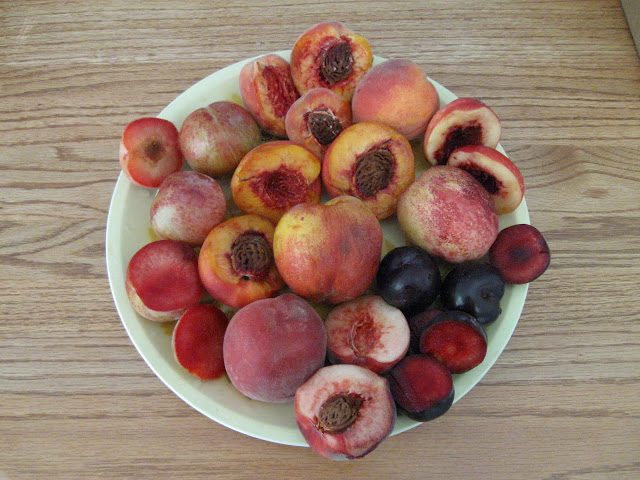
At the top are July Elberta peaches - freestone, suitable for canning (much less firm than cling peaches), great for jam, old-fashioned yellow peach flavor fresh. To the right are some of the last Heavenly White Nectarines - also freestone. Sweet, growing on a vigorous tree. Skin is slightly tough. I may not have watered enough when they were small. I would have bigger fruits on both of the varieties above if I had thinned more carefully.
Below the Heavenly White nectarines are some Burgundy plums. They are sweet, firm, quite mild and red all the way through. They hang well on the tree for quite a while without losing quality. Some people find them similar to Bing cherries. Clingstone. Recommended for drying if you're patient enough to cut the fruit off the pit. The blossoms are self-pollenizing and it is a good pollenizer for second-early blooming plums and Pluots.
At the bottom are Snow Beauty peaches. Freestone. A very nice white peach for California. Above them, in the center, are Fantasia nectarines - an old-fashioned, very flavorful variety - not as sweet as some of the newer ones. Freestone. A great fruit. I learned from "Fruitnut" on the Garden Web that this variety may not produce fruit if not watered well early in the season. I did better this year.
To the left are Dapple Dandy Pluots - the most well-known commercial Pluot. It was once promoted as "dinosaur eggs". Some of the mottled skin coloration comes from a plum parent - Mariposa. They grow on a vigorous, prolific tree. The fruit is firm and sweet. Clingstone. Not the most flavorful Pluot available, but still very tasty. There are some similar-looking varieties which ripen at different seasons which are very inferior in flavor. Their inferior flavor is even noted in the wholesale catalog for the trees. So try to make sure you get the real "Dapple Dandy" if you buy some at a farmer's market or something.
Monday, July 26, 2010
Grandma's Chili Sauce
History and Memories
This is one of the best recipes Mom got from her mother-in-law. It became almost mandatory with roast beef, pot roast, hash or meat loaf. It is also good on scrambled eggs (particularly with fried potatoes) and even in slightly messy sandwiches.
As I recall the story, Grandma got this recipe from a woman's magazine back when women's magazines were newly popular. It calls for "50 tomatoes", which is a little less specific than most recipes for processed foods today. Mom decided that this meant "medium tomatoes". I did a rough measurement with 5 tomatoes, and I figure that this amounts to about 5 or 6 quarts of diced tomatoes. Your results may vary.
I have memories of making this chili sauce as a rather big production: scalding and peeling tomatoes, grinding green peppers and onions (best done outside with a sprinkler running to limit tears) in a food mill (meat grinder). I still think the finished product tastes best when the onions and peppers are ground, but it was a messy business, with a little of the juice running down the back of the food mill onto the floor. Today, you can use a food processor if you like. Aim for onions and peppers diced to a size of about 1/4 inch - less than 1/2 inch in any case.
After following Grandma's recipe for several years, Mom decided to substitute whole spices for the ground spices in the original recipe to produce a redder sauce. She ties the whole spices in a cheesecloth or muslin bag so they can be removed after the sauce is cooked down. The longer the whole spices simmer in the sauce, the stronger the flavor they impart. You can add more whole spices if you prefer a spicier sauce.
I compromise, leaving the celery seed swimming in the sauce and bagging the other spices. (I am partial to celery seed). I have used one of the little nylon tulle circles used to tie up bundles of Jordan almonds for wedding receptions. But you run a very slight risk of melting it if you allow the sauce to scorch during cooking.
The biggest change Mom made in this recipe was adding tomato paste at the end of simmering, which drastically cuts down on the time that you need to cook the sauce down until it is thick. Adding tomato paste also means that there is proportionately more tomato and less of the other ingredients in the final sauce. If you wish to increase the amount of the other ingredients for a zingier sauce, feel free.
According to my calculations from a "home cooking" website, a 12-ounce can of tomato paste is roughly equivalent to 6.6 cups of fresh tomatoes, packed (minus a lot of water). This means that 4 cans of tomato paste is about equivalent to the amount of fresh tomato in the recipe. This little comparison also gives you an idea how long Grandma's version has to be cooked down to produce a thick sauce. Mom's new version is thicker than Grandma's version, however (at least as we prepared it). We didn't use any paste tomatoes, either. So the "sauce" between bits of vegetable tended to be somewhat watery. It was still very good.
Jason also got Mom to add jalapeño peppers for an unusual Chili Sauce Picante (or "Salsa") variation.
Ingredients
50 medium tomatoes (about 6 quarts) peeled, cored and diced to ~ 1/4 inch pieces
5 cups vinegar (we use apple cider vinegar - 5% acidity)
6 Tablespoons sugar (less sweet than most commercial chili sauces)
6 Tablespoons salt (preferably non-iodized: check labels of pickling or kosher salt for equivalent amounts)
1/2 Tablespoon cloves (ground in the original, whole in Mom's version)
1 1/2 Tablespoons allspice (ground in Grandma's version, whole in Mom's version)
2 Tablespoons ground cinnamon or 4 sticks cinnamon, broken
2 Tablespoons celery seed
4 green peppers, cores and seeds removed, ground or diced to ~ 1/4 inch
4 onions, ground or diced
For Mom's updated version: 4 twelve-ounce cans tomato paste
For Chili Sauce Picante
Add ten Jalapeño peppers, cores and seeds removed, minced - or other hot peppers to taste. You may wish to add 2 to 4 Tablespoons of coriander seeds, toasted or not, to your spice bag and omit the celery seed, which doesn't seem very "Mexican". Mom uses celery seed.
Directions
Tie whole spices in a cheesecloth or other food-grade cloth bundle, if using whole spices. Combine all ingredients in a heavy-bottomed kettle and simmer briskly, uncovered until thickened. Stir frequently, particularly as sauce thickens. For Mom's version, cook down for about an hour, add the tomato paste and cook for a few more minutes. Stir frequently as above. Remove the spice bundle.
Pack in cup, 12 ounce or pint canning jars, using normal home canning techniques. Leave 1/2 inch head space. Process in a boiling water bath (covered with boiling water) for 12 minutes if sauce is already hot when processed, about 15 - 18 minutes if sauce has cooled significantly before processing, or for larger jars.
Quarter Recipe
It's much less of a project to make a quarter batch, especially if you use a tomato variety that's easy to peel while raw. Blanching even the easy-to-peel ones may be worthwhile if you make the larger batch above.
You can easily process jars in a large kettle, slightly elevated in a steamer insert, if you have a smooth-topped stove which doesn't work with a typical cold-pack canner. Separate canning jars in the steamer insert with clean, wet washcloths to prevent bumping during processing.
I increased some of the ingredients a little to compensate for the addition of tomato paste, for a result a little closer to Grandma's original, but redder and fresher in flavor like Mom's.
12 to 14 medium-sized tomatoes (about 6 cups peeled, cored and diced)
1 1/2 cups real apple cider vinegar
2 Tablespoons sugar, scant
2 Tablespoons salt, scant
1/2 teaspoon whole cloves
1 heaping teaspoon whole allspice
1 stick cinnamon, broken (I used 1/2 stick each of the assertively-flavored flaky Mexican cinnamon sticks and the harder "standard" cinnamon sticks - they're from different species of tree)
2 teaspoons celery seed, scant
1 large green pepper, diced
1 very large onion, diced
1 twelve-ounce can tomato paste
Saturday, July 24, 2010
Melons, Peaches, Nectarines, Pluots, Giant Caterpillar
It has been hot this week -- as expected this time of year in the valley. Melons and other fruits are ripening at an accelerated pace. Here are some I picked today:

At the top left is my all-time favorite melon, Early Sugar Shaw Hybrid Crenshaw. It shows a little sunscald, typical for these melons if you don't protect the fruits. At the top right is a Lilly Hybrid Crenshaw - almost as big as the Sugar Shaw. I'm looking forward to comparing them because seed of Early Sugar Shaw is no longer available (though I still have some seeds). Next to Lilly are two Heavenly White nectarines and three Geo Pride Pluots. Then comes a little slightly sun-scalded Savor Hybrid Charentais melon. Next to it, if identified correctly, is Summer Dream Hybrid. There are two varieties of melon named Summer Dream. This is the orange-fleshed one from Japan. It is cracked. Watered too late in the ripening process. Charentais melons are also very prone to cracking if watered while ripening.
At the bottom of the photo is a melon of whose identity I'm not sure. It could be one of the Crenshaw varieties above, or Sweet Honda, a yellow-skinned, orange-fleshed melon from Japan. But it looks a lot like Lilly (perspective in the photo makes it look relatively larger than the ones in the back). The little pale melon next to it may be an Extra Summer Sweet. Next to it is another yellow melon - Sweet Honda or a Crenshaw. In the center are F.'s volunteer watermelons. The plant these came from had died back, and the melons may be over-ripe. At the left of the photo are four July Elberta peaches and a Dapple Dandy Pluot (firm-ripe).
Giant Caterpillar

Saturday, July 17, 2010
Ripe Green Tomatoes
This weekend, I picked the first fruits from our three varieties of tomatoes which are green (well, yellow-green) when ripe: They're pictured with some orange and yellow tomatoes for comparison. At the top is Absinthe, our largest green tomato, with a smaller specimen below and to the left. On the right side of the plate are three AAA Sweet Solano, orange with yellow stripes. You may not be able to see the stripes. Next are Green Grape cherry tomatoes in various sizes, and some mystery yellow pears for color comparison. Next going clockwise is Green Zebra - green with yellow stripes. Then some orange cherries, most likely Sun Sugar (they were labeled Sun Sugar Red). Then comes the yellow tomato which was supposed to have been Boondocks.

And there were more red and pink tomatoes. At the rights is the unusually pretty pink tomato which was labeled "Black Krim". It was sold along "German Johnson" and "Arkansas Traveler", so it may be one of those varieties. At the bottom is a huge Anna Maria's Heart. Next on the left is a Giant Belgium - not all that giant. Next going clockwise in another big Anna Maria's Heart and a respectably-sized bicolor Orange Russian 117, which has characteristics of both oxheart and regular-leaf tomatoes.


And there were more red and pink tomatoes. At the rights is the unusually pretty pink tomato which was labeled "Black Krim". It was sold along "German Johnson" and "Arkansas Traveler", so it may be one of those varieties. At the bottom is a huge Anna Maria's Heart. Next on the left is a Giant Belgium - not all that giant. Next going clockwise in another big Anna Maria's Heart and a respectably-sized bicolor Orange Russian 117, which has characteristics of both oxheart and regular-leaf tomatoes.

Wednesday, July 14, 2010
Really BIG tomatoes
Temperatures went down a little after our 107-degree day, but the forecast for tomorrow is 105 degrees. On Saturday, the family who brought their kids over for a planting experience this spring came again to pick tomatoes, peppers, squash and nectarines. The garden is producing well.
We have gotten our biggest tomatoes of the season so far. Some varieties which have, up until now, produced smaller tomatoes have delivered some whoppers. Below are the biggest, with some others for contrast.

In the center is the very biggest specimen - deep as well as wide - a German Head tomato. I think it's the biggest tomato I've ever grown. It has on it some cherry tomotoes (they were supposed to be Sun Sugar Red, but they're probably Sun Sugar) and a penny for size comparison. At the top are three pretty hefty Anna Maria's Heart tomatoes. Then clockwise to what was supposed to have been a big pink beefsteak variety (Boondocks) but which is actually a fairly small yellow variety. Then come two big (for this variety, so far) Black Krim tomatoes with a small, striped Black and Red Boar perched between them and a couple of cherries. To the right side of the platter, three Goose Creek tomatoes - one of the size we have been getting until today, the other two quite a bit larger. Pretty tomatoes.
Next to the Black Krim, at the bottom of the photo is a Marianna's Peace - not large for this variety. Then comes a huge red Jet Setter hybrid fruit. There was another just like it. I was really expecting this to be a medium-sized tomato, along the lines of Celebrity. Perched above these are some AAA Sweet Solano fruits. The yellow on orange striping is quite evident today, even if it doesn't show too well in the photo. Next going clockwise are two Brandy Boys (one to the side of the platter) with a small Ponderosa Pink perched between them. The other tomatoes to the left of the platter are a little Barbara fruit (we're getting lots of these, some much bigger than this one) and a dark, very ribbed JD's Special C-Tex. The shape of this one is quite variable. Above it is a small, beautiful, smooth pink fruit with green shoulders which was supposed to be Black Krim. I bought the plant rather than starting it from seed like the plant that produced the Black Krims on the right. Maybe it's a chance cross or mutation. Maybe it's mislabeled.
Variety Comparisons
Black and Red Boar vs. Nyagous: Both of these little tomatoes are smooth and beautiful. (Black and Red Boar is pictured above and here, in the first photo. Nyagous is pictured in the second photo at the link) Black and Red Boar is heavily striped. Nyagous has a dusky blend of colors. The overall color family of both is similar on the outside. On the inside, Black and Red Boar is dusky pink, without the green coloration typical of the "black" tomatoes. It is soft, slightly sweet and quite flavorful. Nyagous shows light vein-like markings on dusky flesh when peeled - quite distinctive and beautiful. Both tomatoes are quite easy to peel, except for the shoulders on Nyagous. Nyagous is also soft, but is juicer, a little sweeter and has a smoky flavor typical of a black tomato. This was a very ripe specimen.
Black and Red Boar gets the nod for its extraordinary appearance, Nyagous for flavor.
Subscribe to:
Posts (Atom)